01
Helpdesk Queues
Engineers handing hardware across a counter instead of resolving tickets.

Laptops, access cards, onboarding kits, repairs, documents and personal storage all pass through a desk that only works when both people happen to be in the building on the same day. Lockera makes every one of those handovers asynchronous, tracked and self-service.
One system for IT asset issue and return, onboarding and offboarding, day-use lockers, repairs and secure documents.
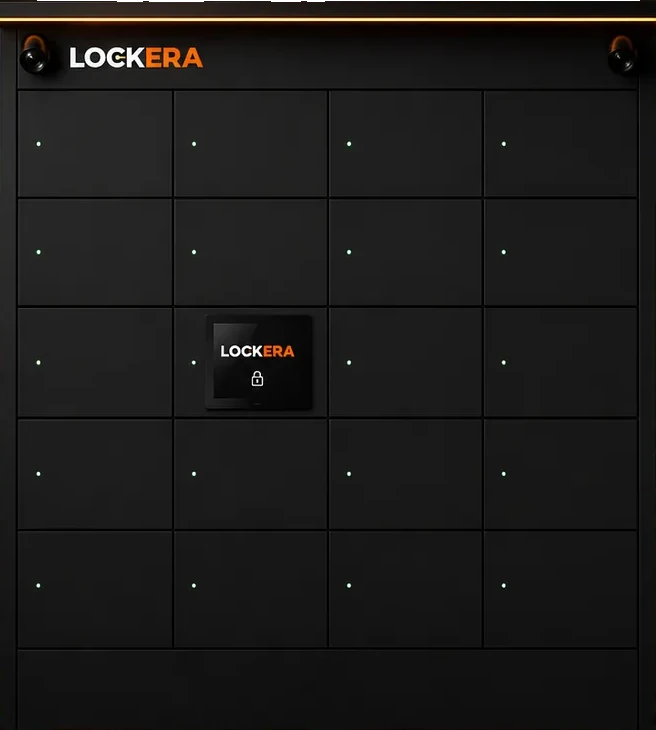
IT asset issue, onboarding kits, repairs, documents and personal storage were all built around both parties being in the building at the same time. With hybrid rosters and split shifts that assumption no longer holds, so handovers queue, slip, or quietly never happen.
Engineers handing hardware across a counter instead of resolving tickets.
IT on site Tuesday, the employee on site Thursday.
New joiners waiting on a laptop that is sitting in a cupboard.
Devices that quietly never come back when somebody leaves.
Assigned lockers for a workforce that no longer has assigned desks.
Contracts, HR files and legal packs moving desk to desk with no record.
How one handover desk turns into a cost across the whole workplace.
5 challenges · 5 operational costs · 1 assumption behind all of them
Lockera is more than an employee locker. It is a handover layer for everything the workplace issues, returns, stores and has to account for — without two calendars having to line up.
Laptops, docks, headsets and phones collected against an employee badge.
Day-one hardware and access cards waiting before the joiner arrives.
Leavers deposit devices with custody recorded at the point of drop.
Faulty device in, loaner out, repaired unit back, all on one ticket.
Personal storage allocated on arrival and released at the end of the day.
Contracts, HR files and legal packs passed with a custody record attached.
| Measure | Manned handover desk | Lockera self-service |
|---|---|---|
| Handover timing | Both parties, same time | Asynchronous, any time |
| Availability | Helpdesk hours | Every shift, around the clock |
| Day-one readiness | Depends on IT being free | Kit waiting before arrival |
| Custody record | A ticket note or signature | Identity-linked at the compartment |
| Offboarding recovery | Chased by email | Enforced with a deposit deadline |
| Locker allocation | Fixed, one per employee | Dynamic, allocated per day |
| Engineer time | Spent at a counter | Spent on tickets |
| Document handover | Passed by hand | Logged at the compartment |
Lockera is a complete hardware, cloud software and access-control stack, engineered for workplaces that issue and reclaim assets continuously.
Modular steel lockbanks with electronic solenoids, HD touchscreens, badge and RFID readers, cameras and battery backup, finished for lobbies, IT floors and workspace zones.
Compartment occupancy by floor and site, asset custody, onboarding and offboarding queues, overdue alerts, document handover logs and a complete audit trail.
Badge, RFID, PIN and mobile access, plus APIs into ITSM, HRIS and asset management so every issue, return and recovery posts against the ticket or the employee record.
Helpdesk load, day-one experience, device recovery and locker capacity all trace back to the same thing: whether a handover needs two people in the same place at the same time.
Take physical handovers off the ticket queue entirely.
Every joiner collects a complete kit on arrival, unattended.
Close the loop on offboarding with a logged, enforced return.
Allocate storage by the day rather than by headcount.
Put a record against every sensitive document that changes hands.
A custody trail for every device and document the organisation issues.
Multi-floor sites with a central IT and facilities function.
Large engineering populations on rotating hybrid patterns.
Round-the-clock shifts needing secure personal storage.
Distributed offices run by one IT and facilities team.
Workspaces with no fixed seat allocation.
Banking, insurance and healthcare back offices with strict custody rules.
We map headcount, attendance patterns, the asset catalogue and handover volumes.
Compartment mix, floor placement, allocation rules and access model.
Installation, badge enrolment, and integration with ITSM, HRIS and asset management.
Employees, IT and facilities start issuing, returning and collecting immediately.
IT places the device in a compartment and assigns it to the employee. The employee receives a notification with a single-use code and collects at the unit using their badge, RFID card, PIN or the mobile app. Custody transfers the moment the door closes, so neither side has to be in the building at the same time.
The kit - laptop, dock, headset, access card, whatever the role needs - is loaded into a compartment ahead of the start date and assigned against the joiner's record. They collect it on arrival without an appointment, and the issue posts back to your HR and asset systems as a completed onboarding step.
Offboarding creates a return task with a deadline. The leaver deposits the device into a compartment, and custody is recorded at the point of drop rather than resting on an email chase. Anything still outstanding shows on the dashboard with the holder's name against it, which is usually the difference between a device coming back and being written off.
Yes. Day-use allocation gives an employee a compartment when they badge in and releases it when they leave, so a hot-desking floor needs capacity for the people actually present rather than one locker per name on the payroll. Fixed assignment is still available where a role needs it.
Yes. A faulty device is dropped into a compartment and a loaner issued in the same visit. When the repair is done the unit goes back into a compartment for collection, with every leg of the journey attached to the same ticket.
Lockera exposes APIs for issue, return, custody and assignment events, so handovers post against the originating ticket, the employee record or the asset register. Joiner and leaver events can trigger locker tasks automatically rather than being raised by hand.
The building access badge is the usual choice, since people already carry it. RFID, PIN and the mobile app all work as alternatives, and rights follow the person, so one credential works across every bank, floor and office.
Yes. Banks are managed as a single estate with role-based access, so a facilities or IT team sees occupancy, custody and overdue items across every floor and site from one dashboard, while local admins see only their own.
Each unit carries battery backup and an offline cache. Employees continue collecting and depositing with offline PIN codes through a full grid or connectivity failure, and the custody log reconciles once the unit is back online.
Turn every workplace handover into something that happens on its own, whenever either side is on site.
Discover how Lockera helps workplaces issue, recover and store assets without a queue at a counter.