01
A Trip Across the City
Citizens travelling to a single office to collect one document.

Citizens apply online, pay online and track online — then travel across the city, during office hours, to collect a document from a counter. Lockera gives a city a network of secure collection points, so the last step of a digital service stops being a queue.
One network for citizen document collection, public storage, field crew issue and inter-department transfer.
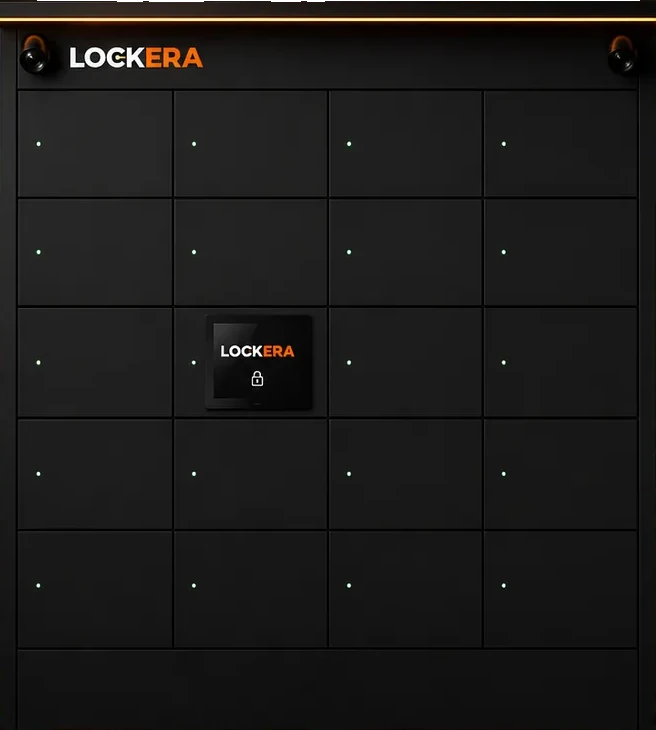
A city can digitise application, payment and status tracking, and still hand over the result across a counter that opens at ten and closes at five, in one building, in one part of the city.
Citizens travelling to a single office to collect one document.
Services available exactly when most people are at work.
Footfall concentrated on a handful of service points.
Person-to-person exchange with no record of what passed.
Tools and PPE issued from depots that are rarely staffed.
Each department running its own arrangement, with no shared picture.
How one service window turns into a cost across the whole city.
5 challenges · 5 public costs · 1 service window behind all of them
Lockera is more than a public locker. It is a city-scale handover layer for documents, equipment and goods that currently move across a counter — sited where citizens already are.
Certificates, licences and cards collected near home, at any hour.
Secure short-term storage at transit hubs, markets and civic centres.
Tools, PPE and meters drawn at depots and ward offices on any shift.
Files and equipment passed between offices with a record attached.
Helmet storage and battery handover for shared vehicle schemes.
Kits, books and entitlements distributed without a queue.
| Measure | A service counter | A Lockera city network |
|---|---|---|
| Collection location | One office | A network across the city |
| Service hours | Counter hours | Around the clock |
| Citizen travel | Across the city | To the nearest point |
| Queue | Concentrated at a window | Parallel, self-service |
| Handover record | A signature in a register | Identity, time and image |
| Staffing | A clerk per counter | Unmanned |
| Coverage growth | A new office | A new bank |
| Oversight | Department by department | One city-wide dashboard |
Lockera is a complete hardware, cloud software and integration stack, engineered for networks that span a whole city rather than a single building.
Modular steel lockbanks with electronic solenoids, multilingual touchscreens, cameras and battery backup, specified for civic buildings and outdoor public siting, in weather-proof and vandal-resistant configurations.
Occupancy and utilisation per site and per ward, collection and dwell reporting, unit health, department-level access and a complete audit trail across the estate.
Single-use OTP and QR collection with multilingual guidance, plus APIs into service-delivery portals so the citizen is notified and authorised through the channel they already applied on.
Citizen travel, service hours, accountability and reach all trace back to one decision: whether a public handover happens at a counter, or at a point close to where the citizen already is.
Make the handover as digital as the application already is.
Collection points sited where people already go.
Public services that do not close at five.
Put a verifiable record behind every public exchange.
One network, many wards, a single dashboard.
Tools and PPE issued at any depot, on any shift.
Ward offices and civic centres across a metro.
New public infrastructure delivered as a network.
Stations, interchanges and depots.
Water, power and sanitation field operations.
Storage sited where citizens already gather.
The physical last mile of an online service.
We map services, volumes, ward coverage and candidate sites.
Site selection, compartment mix, outdoor specification and language set.
Installation plus integration with service-delivery portals and department systems.
Citizens, field crews and departments start collecting immediately.
When the department places the document in a compartment, the citizen is notified through the same channel they applied on, with a single-use OTP and QR code. They go to the nearest point in the network, enter the code, and the compartment opens. No appointment, no queue and no travel to the issuing office.
The single-use code is issued against the application record and delivered to the registered mobile number, so possession of the code is tied to the applicant. Where a service needs more, a second factor can be required at the unit, and every opening is recorded with a timestamp and a camera capture.
Yes. Weather-proof and vandal-resistant configurations are specified for footpaths, transit forecourts, market squares and ward office frontages, with battery backup where supply is intermittent.
The touchscreen is multilingual and the language set is chosen per site, which matters for a public service that must be usable by every resident rather than only those comfortable in English.
The department sets a holding window per service. Lockera sends reminders as it closes, flags the item once it passes, and lists everything overdue by ward so the document can be retrieved and handled under the department's own process rather than occupying a compartment indefinitely.
Yes, and at city scale that is usually the point. Banks run multi-tenant with per-department accounts, permissions and reporting, so a single point can serve several services while each department sees only its own items.
Lockera exposes APIs for compartment allocation, notification triggers, collection events and status callbacks, so a service can move through applied, ready and collected inside the portal the citizen already uses, with no separate system for them to learn.
One dashboard covers the whole estate: occupancy and utilisation per site and per ward, collection and dwell times, overdue items and unit health, with role-based views so a ward officer, a department and a central programme team each see the right scope.
Each unit carries battery backup and an offline cache. Citizens and field crews continue collecting with offline codes through a full grid or connectivity failure, and the record reconciles once the unit is back online.
Give every online service a physical last mile that works as well as the application already does.
Discover how Lockera helps cities deliver public services closer to where citizens already are.