01
Queues at the Cloakroom
One counter meeting an entire arrival or checkout wave.

Guests who have checked out, travellers between connections, and pilgrims who cannot carry a bag inside all need somewhere secure to leave something — and they all need it at the moment the counter is busiest. Lockera turns storage into self-service that scales with the crowd instead of with the roster.
One system for hotel left luggage, transport hubs, attraction cloakrooms and pilgrim deposit.
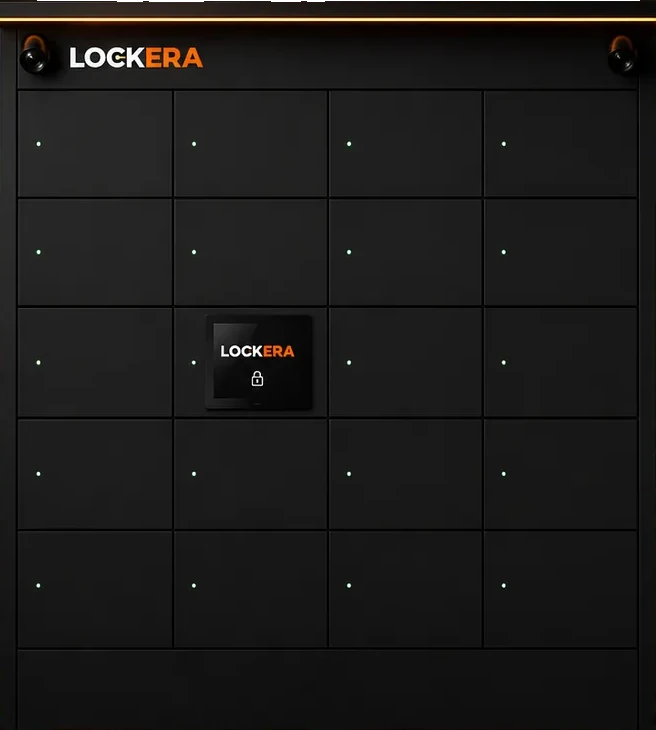
Checkout hour, the arrival of a train, the start of darshan — storage demand comes in a wave, and a manned cloakroom meets it with one attendant, one queue and a paper token.
One counter meeting an entire arrival or checkout wave.
Bell desk and front office time spent tagging and retrieving bags.
Paper and plastic tags that go missing, leaving a disputed claim.
A cloakroom that closes while travellers are still moving.
Festival, event and pilgrimage days that dwarf ordinary volume.
No record of what was deposited, by whom, or when.
How one manned counter turns into a cost across the whole site.
5 challenges · 5 operational costs · 1 manned counter behind all of them
Lockera is more than a luggage locker. It is self-service storage for every moment a visitor cannot carry what they are holding — sized for a crowd that arrives all at once.
Guests store bags before check-in and after checkout, on their own schedule.
Travellers between connections deposit and collect without a counter.
Phones, footwear, leather and electronics deposited in seconds before entry.
Bags, coats and equipment stored while visitors move freely.
Pay-per-hour storage with no staff involved in the transaction.
Secure personal storage for hotel, venue and hub employees.
| Measure | Manned cloakroom | Lockera self-service |
|---|---|---|
| Availability | Cloakroom hours | Around the clock |
| Staffing | An attendant on duty | Self-service |
| Peak handling | One queue, one counter | Parallel access |
| Claim method | A paper or plastic token | A single-use digital code |
| Deposit record | A handwritten log | Timestamped, with an image |
| Languages | Whatever staff speak | Multilingual touchscreen |
| Payment | Cash at the counter | Self-service, per hour or day |
| Surge capacity | More staff on shift | More compartments |
Lockera is a complete hardware, cloud software and self-service payment stack, engineered for sites where the crowd arrives faster than a counter can serve it.
Modular steel lockbanks with electronic solenoids, HD multilingual touchscreens, cameras and battery backup, sized from phones and footwear to large suitcases and specified for lobbies, concourses and open-air approaches.
Live occupancy per site, dwell and overstay alerts, deposit and collection logs, utilisation and revenue reporting, and a complete audit trail.
Single-use PIN and QR access with multilingual guidance, self-service payment by UPI or card, and APIs so a booking reference or event ticket can act as the credential.
Queue length, staff cost, service hours and liability all trace back to the same thing: whether storage needs a person standing behind a counter.
Meet an arrival or darshan wave without adding headcount.
Take storage off the bell desk and the front office.
Replace a losable tag with a code tied to the depositor.
Offer storage when a cloakroom would be closed.
Charge per hour or per day with no staff in the transaction.
Multilingual self-service instead of a language barrier at a counter.
Pre-check-in and post-checkout storage without the bell desk.
Left luggage on concourses and at transport interchanges.
High-throughput deposit of items not permitted inside.
Cloakroom service for bags, coats and equipment.
Surge storage for delegates and audiences.
Secure storage at beaches, parks and activity sites.
We map visitor volumes, peak windows, item sizes and placement options.
Compartment sizing, bank placement, pricing model and language set.
Installation, payment setup, and integration with PMS or ticketing where required.
Guests, travellers and pilgrims start depositing and collecting immediately.
They choose a compartment size at the touchscreen, pay if the site charges, and the door opens. Closing it issues a single-use PIN and QR code to their phone. Collection is the same code at the same bank. No attendant, no token and no paperwork.
Banks are configured from the site's own mix, typically small compartments for handbags, phones and footwear through to large ones for suitcases and rucksacks. The touchscreen shows what is free in each size, so a visitor is never sent to a counter to ask.
Self-service at the unit, by UPI or card, charged per hour or per day depending on how the site prices storage. Free allocation is equally possible where storage is a guest service rather than a revenue line, and a hotel can let a booking reference stand in for payment.
This is the highest-throughput case Lockera handles. Banks are sited before the entry point with a large number of small compartments, so a queue of visitors can each deposit prohibited items in a few seconds and collect them on the way out with a single-use code. Capacity is added by adding modules ahead of a festival rather than by adding staff.
You set a maximum dwell per site. Lockera sends reminders as the window closes, flags the compartment once it passes, and lists everything overdue on the dashboard with its deposit time and image so staff can clear it under your own lost-property process.
Yes. Weather-proof configurations are specified for concourses, forecourts, temple approaches, beaches and park entrances, with battery backup where mains supply is unreliable.
Yes. APIs let a booking reference, room number or ticket act as the credential, so a guest who has checked out can still open their compartment, and an event can issue storage as part of the ticket rather than as a separate transaction.
The touchscreen is multilingual and the language set is chosen per site, which matters at a transport hub or pilgrimage site where visitors will not share a language with whoever would otherwise be behind the counter.
Each unit carries battery backup and an offline cache. Visitors continue depositing and collecting with offline PIN codes through a full grid or connectivity failure, and the deposit log reconciles once the unit is back online.
Turn left luggage from a staffed queue into self-service that scales with the crowd.
Discover how Lockera helps hotels, hubs and pilgrimage sites serve a peak without adding a counter.