
Parcel Lockers vs a Manned Mailroom
This comparison is usually framed as replacement, which is the wrong frame. A manned mailroom and a locker bank solve overlapping but different problems, and the sites that get the best result from lockers are generally the ones that were honest about what the mailroom was genuinely good at. Here is how the two actually compare in operation, including the cases where a desk is still the better answer.
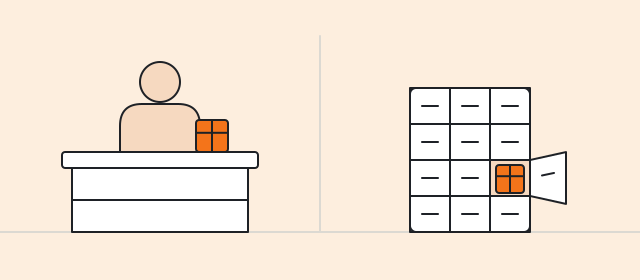
How each one actually works
A manned mailroom concentrates every handover at one point and one person. A courier hands over, a human signs, the item is logged somewhere, and the recipient collects later during the hours that person is present. The strength of this model is judgement: a human can take a decision about an unusual item, an unexpected courier or an exception nobody wrote a rule for.
A locker bank removes the person from the middle. The courier deposits into a compartment and it locks; the recipient is notified and collects with a credential, at whatever hour suits. The strength here is that neither party has to be present at the same moment, and every opening is recorded against an identity without anyone writing anything down.
Side by side
| Measure | Manned mailroom | Locker bank |
|---|---|---|
| Collection hours | The hours the desk is staffed | Any hour the building is open |
| Handover record | A signature or a logbook | Identity and timestamp, per door |
| Peak handling | One queue, one counter | Parallel, limited by compartments |
| Unusual items | Handled on judgement | Needs a defined exception route |
| Staff time | Continuous, through the day | At exceptions and retrieval only |
| Audit | Reconstructed from records | Exportable from the log |
| Failure mode | Absence, queues, disputes | Full bank, uncollected items |
Where a manned mailroom still wins
Being straight about this is worth more than a sales argument, because specifying lockers into one of these situations produces an expensive disappointment.
- High-value or high-exception traffic. Sites where a large share of what arrives needs a decision rather than a compartment — legal documents, bespoke goods, items requiring inspection on receipt.
- Very low volume. A handful of items a day through an already-staffed reception does not justify infrastructure.
- Items that do not fit lockers at all. If most of your traffic is pallets, furniture or outsize goods, a bank addresses the minority of your problem.
- Concierge as the service. In buildings where the front desk is part of what residents or tenants are paying for, removing the interaction removes the product.
Where lockers win
- Collection outside staffed hours. The single most common complaint about a mailroom is that it is shut when people get home.
- Peaks. A counter serves one person at a time; a bank serves everyone who has a code.
- Provable custody. Identity, time and door, captured automatically rather than reconstructed from a book when something is disputed.
- Recovering staff time. Reception stops being parcel storage and goes back to the job it was hired for.
- Multi-site visibility. One view across several buildings, which a set of separate logbooks cannot give you.
The arrangement most sites actually end up with
Not a replacement: a split. The bank absorbs the volume — the predictable, parcel-shaped majority that simply needs to change hands securely — and the desk keeps the exceptions, the oversized items and the judgement calls. Staff time moves from processing everything to handling the few things that genuinely need a person.
That split is also the honest way to size a deployment. If you specify a bank to take one hundred per cent of traffic you will oversize it and still have exceptions; if you specify it to take the parcel-shaped majority, it is smaller, cheaper and it works.
Not "can lockers replace the mailroom", but "what share of what arrives is parcel-shaped and predictable". That share is what the bank is for, and it is usually most of it.
How to decide
Three questions settle it for most sites. What proportion of arrivals would fit a compartment and need no judgement? How much of the complaint volume is about collection hours rather than about handling? And what is reception currently not doing because it is minding parcels?
If the answers are "most of it", "mostly hours" and "quite a lot", a bank will pay for itself in experience before it does in staff cost. If they are not, a desk is still the right answer and it is worth saying so.
Size it on the split, not the total
We work out what share of your arrivals is parcel-shaped and predictable, and specify a bank for that rather than for everything. It is usually smaller than people expect.
Book a Site SurveyFrequently asked questions
Do parcel lockers replace a mailroom entirely?
Usually not, and specifying as though they will tends to produce an oversized bank that still has exceptions. The common outcome is a split: the bank takes the predictable, parcel-shaped majority and the desk keeps oversized items and judgement calls, with staff time moving to exceptions.
What happens when the bank is full?
A full bank is the main failure mode, and it is almost always a sizing or a dwell-time problem rather than a hardware one. Holding windows, reminders and an uncollected-item policy keep compartments circulating; sizing on peak rather than average volume keeps headroom on the days that matter.
Can couriers use a locker bank without being registered first?
Yes. The deposit flow is designed so a courier who has never seen the unit can complete a delivery without installing anything or being registered in advance, which is the condition for it working at all across many carriers.
Does a locker bank give better proof of delivery than a signature?
It captures identity, time and the specific door, automatically, for both deposit and collection, and that record is exportable. A signature records that somebody took something at some point. Which matters depends on how often you need to settle a dispute.
Which industries does this apply to?
The same split shows up across enterprises and offices, residential communities and logistics operations, with different exception traffic in each.
More from Lockera
What Actually Drives the Cost of a Smart Locker System
Seven decisions move the number more than anything else. Settle them before you ask for a quote.
Specifying Parcel Lockers for an Apartment Community
Twelve things to settle before installation, and five mistakes that are expensive to undo afterwards.